
Criminal Court Records in Coffee County
A Coffee County criminal court record is the case file maintained after a criminal matter is opened in the court system. The Coffee County Circuit Clerk is the record keeper and business manager for Circuit Court and District Court proceedings, including criminal, traffic, warrants, juvenile, civil, domestic relations, and other divisions. Criminal records can include a complaint, warrant, bond, preliminary hearing, indictment or no bill, arraignment, plea, motions, disposition, sentence, court costs, and probation orders. For the narrower arrest-to-charge path, use arrest records and court charge records; for the broader record universe, use all Coffee County court records.
Coffee County criminal jurisdiction depends on the court stage. District Criminal handles misdemeanor cases such as worthless checks, conservation tickets, revenue commission tickets, and ABC violations. A felony begins in District Criminal until it is presented to and disposed of by a grand jury. After indictment, felony prosecution belongs in Circuit Court. Enterprise Municipal Court is separate and handles city traffic and ordinance matters. Custody status is a sheriff or jail issue, so a person looking for who is currently in jail should use Coffee County inmate records. Active warrant questions may involve the Circuit Clerk, Sheriff's Office, jail, Enterprise Municipal Court, or traffic channels, so warrant records use a separate access path.
The U.S. District Court for the Middle District of Alabama homepage is one of the criminal-records image sources assigned in the manifest.
That federal source is relevant only when a matter is in federal court. Ordinary Coffee County misdemeanor and felony case files are state trial-court records unless a federal prosecution or federal filing exists.
How to Search Coffee County Criminal Court Records
The main online source for Coffee County District and Circuit criminal case reports is Alacourt ACCESS / Just One Look. Alacourt says it provides on-demand access to Alabama trial court records and lists criminal records among the available categories. The local Circuit Clerk site at coffee.alacourt.gov identifies Amy L. Reeves as Coffee County Circuit Clerk, but it does not publish a free county-only criminal case search; the online path is statewide and paid. A name search or case-number search is $9.99, one case detail report is included with the search, and document image fees apply when images are available.
- Open Alacourt ACCESS for Coffee County Circuit or District criminal case information if paid online access is acceptable.
- Search by defendant name or case number, then confirm the returned case is the correct Coffee County matter.
- Read the court, division, status, setting dates, party information, financial history, and detailed case action summary.
- Check whether the docket shows a misdemeanor, initial felony proceeding, indictment, no bill, plea, dismissal, nolle prosequi, disposition, sentence, costs, or probation order.
- Contact the Coffee County Circuit Clerk at Enterprise, (334) 347-2519, or Elba, (334) 897-2954, for certified copies, older files, records not visible online, or help with division assignment.
Statewide criminal-history and expungement questions are different from a court case lookup. ALEA's expungement page states that Alabama courts grant expungements under Code of Alabama Title 15, Chapter 27, and that ALEA does not grant expungements or give legal advice. A court case report may help locate the case number and disposition needed for an expungement petition, but the petition itself is filed with the criminal division of the circuit court where charges were filed. For custody after arrest, use Sheriff Scott Byrd's Coffee County Sheriff's Office or the County Jail. For prosecution questions, the county directory lists District Attorney James Tarbox at the Enterprise office.
Stages of a Criminal Case
Criminal court records should be read as a process, not as a single event. A person may be arrested or cited, a complaint or charge may open a District Criminal case, bond or conditions may be set, and a preliminary hearing or other early setting may appear. A felony can begin in District Criminal and remain there until the grand jury acts. If the grand jury indicts, the Circuit Court handles the felony prosecution. If the grand jury returns no bill, the record may show that no indictment was issued. Misdemeanors and many traffic-related matters may remain at the district or municipal level.
Case flow: Charges Filed › Arraignment › Pretrial / Motions › Plea or Trial › Disposition › Sentencing
| Stage | What Happens |
|---|---|
| Charges Filed | A complaint, citation, warrant-related filing, indictment, or other charging entry identifies the alleged offense and starts or advances the criminal case. |
| Arraignment | The defendant is formally advised of the charge and enters a plea, such as guilty or not guilty, when the court process reaches that stage. |
| Pretrial / Motions | The docket may show motions, hearings, subpoenas, bond activity, continuances, plea discussions, or other court actions before disposition. |
| Plea or Trial | The case may resolve by plea, trial verdict, dismissal, no bill, nolle prosequi, or another court-approved disposition. |
| Sentencing | If there is a conviction, the record may show sentence, court costs, fines, restitution, probation, or other orders. |
The Middle District of Alabama division page is an assigned image source for criminal records.
The research identifies Coffee County as part of the Middle District of Alabama's Southern Division served by Dothan for federal matters, separate from Coffee County's state Circuit and District Court criminal case flow.
What a Coffee County Criminal Court Record Shows
Alacourt's report inventory provides the best official field list without opening a paid Coffee County criminal case. A case detail report can include basic case information, court action, case status, setting dates, party information, financial history, detailed case action summary, document images, and attachments. Criminal cases add charge-specific terms such as complaint, warrant, bond, indictment, no bill, arraignment, plea, disposition, sentence, costs, and probation orders.
| Field | What It Shows |
|---|---|
| Case Number | The identifier assigned after the criminal case, citation, or felony proceeding is processed. Use it when contacting the clerk. |
| Defendant | The person accused in the State or City criminal case. Juvenile and Youthful Offender records may be restricted. |
| Court / Division | District Criminal for misdemeanors and early felony proceedings, Circuit Court after indictment, or municipal court for Enterprise city matters. |
| Charges | The alleged offense or offenses, which may be pending, amended, dismissed, no-billed, nolle prossed, disposed, or replaced by indictment. |
| Plea | The defendant's formal response, such as guilty or not guilty, when the case reaches arraignment or plea stage. |
| Settings and Actions | Hearing dates, preliminary hearing, arraignment, motion practice, subpoenas, continuances, trial settings, and court actions. |
| Disposition | The result of a charge or case, including guilty, dismissed, no bill, nolle prosequi, acquittal, or other case-ending action. |
| Sentence and Costs | Sentence, court costs, fines, restitution, probation orders, financial history, and related payment or enforcement activity where shown. |
Charges vs. Convictions
A criminal charge is an accusation or court filing. A conviction is the result of a guilty plea, verdict, or other conviction-producing disposition. Coffee County criminal court records can show charges that were pending, amended, dismissed, no-billed, nolle prossed, or disposed without a conviction. Reading a docket entry as a conviction simply because it lists a charge is inaccurate. Confirm the disposition, plea or verdict, sentence, and any later expungement or sealing activity before drawing conclusions.
| Charge | Conviction | |
|---|---|---|
| Stage | Accusation or formal case allegation. | Outcome after guilty plea, verdict, or qualifying disposition. |
| Proof Level | May begin with probable cause, complaint, citation, warrant, or indictment. | Requires a court result that supports conviction and sentencing. |
| Public Record | Often public unless juvenile, sealed, expunged, confidential, or otherwise restricted. | Often public unless sealed, expunged, confidential, or restricted by law or order. |
| Coffee County Example | A District Criminal entry showing a misdemeanor charge or initial felony filing. | A disposed Circuit or District case showing guilty plea, verdict, sentence, and costs. |
Reading Dispositions and Sentences
Disposition is the outcome of a charge or case. Coffee County records may show pending, disposed, dismissed, no bill, indicted, nolle prossed, paid, unpaid, warrant issued, or other status language depending on the case type. In a felony path, "indicted" shows that the grand jury returned a charging instrument and the case may proceed in Circuit Court. "No bill" means the grand jury did not indict. "Nolle prossed" means prosecution was not pursued on that charge. A dismissed charge is not the same as a conviction, and an unpaid cost or warrant-related entry does not automatically describe the original offense outcome.
A sentence may appear after a guilty plea or conviction and can include court costs, fines, restitution, probation, or other orders. For court-ready proof of outcome, request a certified disposition from the Circuit Clerk rather than relying only on a screenshot or third-party summary. If the person is in custody, the jail or ADOC status is a separate custody record and may change independently of the criminal case docket.
Sealed vs. Expunged Records
Alabama expungement is governed by Title 15, Chapter 27. ALEA states that Alabama courts, not ALEA, grant expungements. In practice, the person usually needs to identify the exact Coffee County charge, court, disposition, and case number, then file a petition in the criminal division of the circuit court where the charge was filed. Sealing and confidentiality can also arise from juvenile law, Youthful Offender treatment, adoption records, mental-health commitments, or a specific court order.
| Sealed | Expunged | |
|---|---|---|
| Visibility | Blocked from general public inspection by law or court order. | Removed from normal public access under an Alabama court expungement order. |
| Authority | May come from juvenile confidentiality, Youthful Offender status, adoption rules, commitments, or a sealing order. | Granted by an Alabama court under Title 15, Chapter 27 when statutory requirements are met. |
| Agency Role | The clerk follows the law or court order that limits public access. | ALEA explains it does not grant expungements and cannot provide legal advice. |
| Eligibility | Depends on the record category and order. | Depends on the charge, disposition, statute, petition, service, objections, and court ruling. |
The PACER CM/ECF lookup page for the Alabama Middle District is one of the assigned criminal-record images.
PACER applies to federal court records, not ordinary Coffee County state criminal cases, but it is the correct channel when a Coffee County-related matter is filed in the Middle District of Alabama.
Public Access to Criminal Court Records
Alabama's public-records framework supports inspection and copying of nonconfidential public records, but criminal court records are not all equally public. Code of Alabama Section 36-12-40 gives citizens a right to inspect and copy public records unless a statute provides otherwise. Section 36-12-41 addresses copies and lawful fees. Sections 36-12-43 through 36-12-46 add procedure, timing, clarification, written-procedure, and request-form provisions. Section 12-15-133 makes juvenile court and law-enforcement records involving children confidential except as permitted by statute.
Key Statutes:
Code of Alabama § 36-12-40 - Citizens may inspect and copy public records unless another statute restricts access.
Code of Alabama Title 15, Chapter 27 - Alabama courts grant eligible criminal-record expungements.
Code of Alabama § 12-15-133 - Juvenile court and related law-enforcement records involving children are confidential except as allowed by law.
Background Check Considerations
A casual criminal court lookup is not the same as a legally compliant background check. Coffee County court records can help locate public case information, but they may be incomplete, delayed, restricted, sealed, expunged, or limited to a particular court system. Employment, tenant screening, credit, insurance, and other regulated decisions require proper legal compliance and cannot rely on an informal public-record search. Official certified dispositions should come from the Circuit Clerk when a criminal case outcome must be verified.
Important: Coffee County Court Records is not a consumer reporting agency and cannot be used for FCRA-regulated screening decisions.
Restricted Criminal Court Records in Coffee County
Restricted criminal records include juvenile matters, Youthful Offender cases, sealed cases, expunged charges, protected personal identifiers, and records withheld because of law, court order, or ongoing sensitivity. Enterprise Municipal Court's defendant instructions note that defendants under 21 may petition for Youthful Offender status and, if granted, the case will be treated as confidential and sealed by the court. Public-facing court systems and clerk copies should redact Social Security numbers, minor identifiers, protected personal identifiers, protected medical information, and victim-safety information where required.
The U.S. Attorney's Office for the Middle District of Alabama district page is the final assigned image source for this criminal-records page.
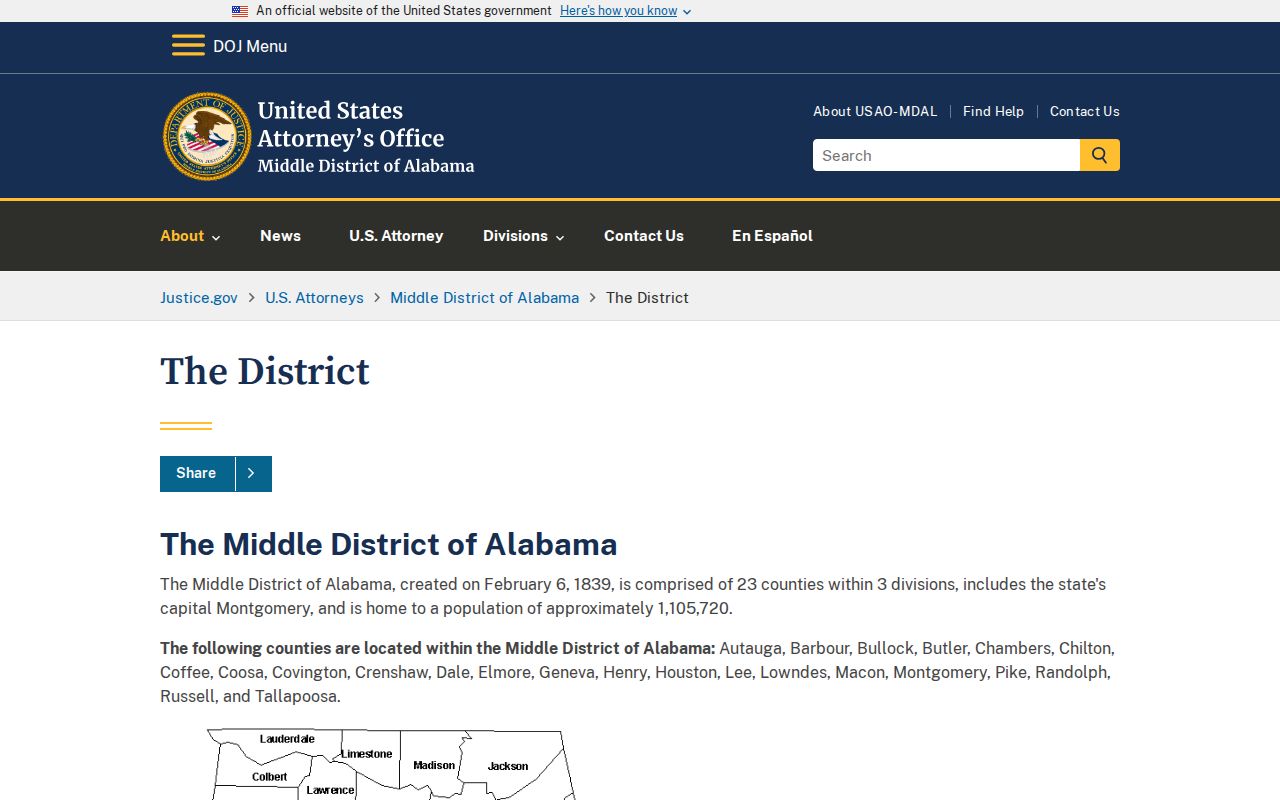
The U.S. Attorney source helps distinguish federal prosecution from Coffee County state prosecution, where the local District Attorney and state courts handle ordinary state criminal cases.